
If there’s one casino game that perfectly mixes simplicity with a hint of strategy, it’s blackjack. Whether you’ve wandered into a casino in Manchester, fired up an online table on your phone, or just played a few rounds with mates for bragging rights, the aim has always been the same: get as close to 21 as possible without going over. Sounds easy enough, right? Well, yes and no.
This guide takes you through what blackjack actually is, how a typical game plays out, what those terms like hit, stand, and double down really mean, and how to read a table so you look like you belong there.
What You’re Trying to Do
At its core, blackjack is a battle between you and the dealer, not the other players around the table. You both get dealt cards, and whoever ends up closer to 21 wins. Go over, and you “bust.” The beauty of the game is that it’s simple to follow, but every decision you make carries a bit of tension.
Cards two through ten are worth their face value. Face cards (kings, queens, and jacks) count as ten. Aces can count as one or eleven, depending on what helps your hand most. So, if you’ve got an ace and a six, that’s either seven or seventeen, whichever gives you the better shot. That flexibility makes the ace your best friend.
The Layout of a Blackjack Table
If you’ve ever looked at a blackjack table and wondered where to even sit, don’t worry, they all follow roughly the same setup.
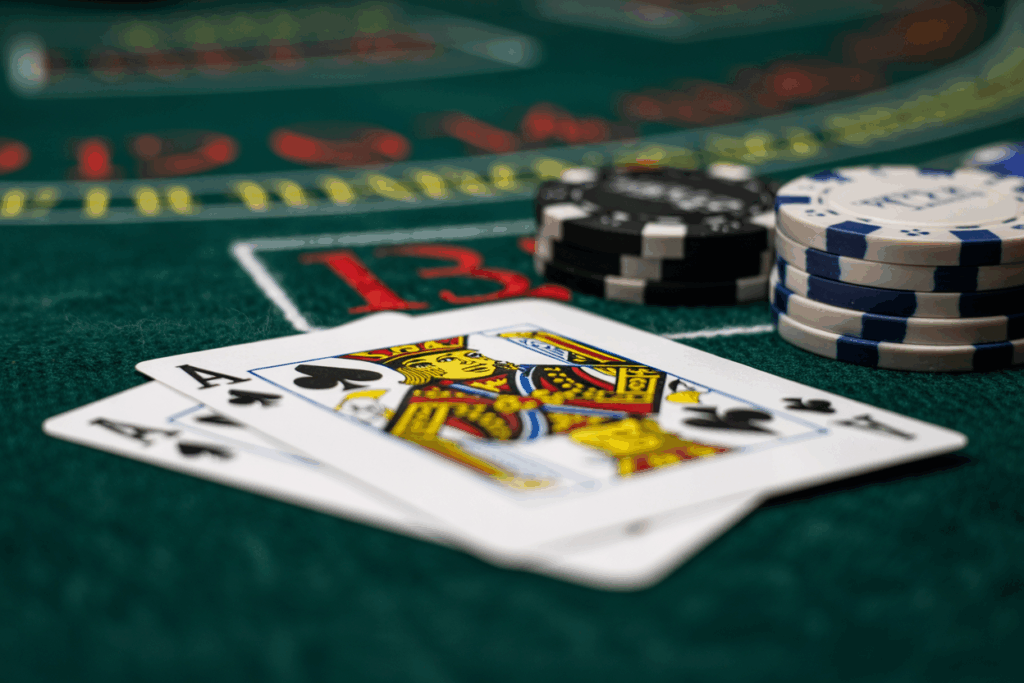
Each player spot has a betting circle. That’s where your chips go before the cards are dealt. The dealer stands behind the semi-circular table, with a shoe full of cards on their left and a chip tray in the centre.
Above or near the dealer, you’ll often see text like “Blackjack pays 3 to 2” or “Dealer must draw to 16 and stand on all 17s.” This isn’t just decoration; it’s how you know the rules of that particular table. The payout ratio tells you what you’ll win if you land a natural blackjack (an ace and a ten-value card), and the dealer rule shows how far they must go when drawing cards.
If you’re playing online, the setup looks similar, only cleaner and often with on-screen buttons for every move. You’ll usually find your balance at the bottom, the dealer’s cards in the middle, and your betting options laid out neatly below your hand.

How a Typical Hand Works
- Place your bet.
You’ll see a minimum and maximum limit. Online tables can start as low as 10p or 50p, while casino tables might begin at £5. - The deal.
You get two cards face-up. The dealer gets one face-up and one face-down. - Your move.
Now you choose to hit (take another card), stand (stick with what you’ve got), double down (double your bet, take one more card), or split (only if you’ve got a pair, this creates two separate hands). - The dealer’s turn.
Once everyone’s finished, the dealer flips their hidden card and keeps hitting until they reach at least 17. - The result.
Whoever’s closest to 21 wins. Simple.
A blackjack, that perfect ace plus a ten or picture card, is the best hand possible and usually pays out at 3:2. That means a £10 bet nets you £15 profit.
Reading the Table Like You Know What You’re Doing
Here’s where you start to feel more confident. A good blackjack player knows how to “read the table.” That means watching what’s already in play and making decisions that make sense in context.
If you’re sat at a table and the dealer’s showing a weak card (say, a 5 or 6), you might stand on a lower total, knowing there’s a decent chance they’ll bust. If the dealer’s showing a strong card (like a 10 or ace), you might be more aggressive with hits or doubles.
Don’t worry about what the other players are doing; they don’t affect your odds. Every hand is a new battle between you and the house.
Online Blackjack vs. In-Person
Playing online gives you time to think without the pressure of other players waiting for your move. You’ll often get handy visual cues and quick links to basic strategy charts. Live dealer versions, on the other hand, replicate the casino feel, complete with a real human dealer streamed in HD.
If you’re in the UK, always play on a site licensed by the Gambling Commission. That means the games are tested for fairness, and your funds are protected. Look for logos or licence numbers in the footer of the site before you start betting real money.
Common Beginner Mistakes
Even though blackjack is simple, players often trip up in a few classic ways:
- Hitting on 17, most of the time, is asking for trouble.
- Ignoring the dealer’s upcard, your decisions should depend on what they’re showing.
- Not splitting aces and eights, this is almost always the right move.
- Chasing losses, it’s easy to think “one more hand,” but that’s how the house wins.
The best approach? Set yourself a budget before you sit down, treat it as entertainment spend, and quit while you’re ahead (or at least not too far behind).
Blackjack has been around for centuries, and there’s a reason it’s stood the test of time. It’s quick, smart, and gives you that feeling of control that other casino games don’t quite match. Whether you’re learning online, joining a live table, or just trying to look like you know what you’re doing at the local casino, these basics are all you need to get started.