
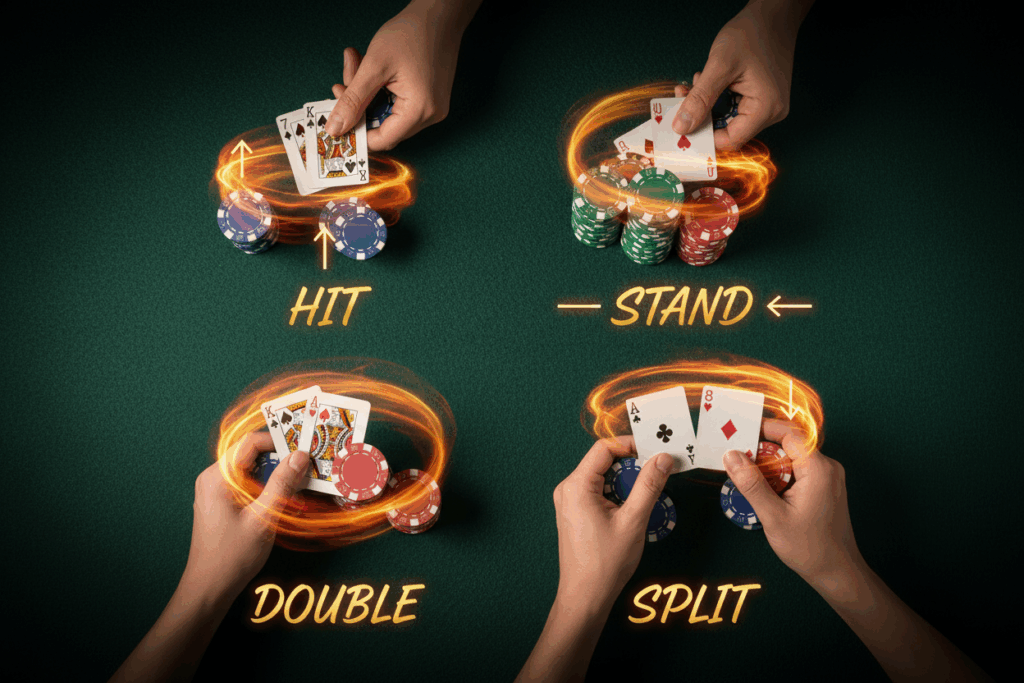
Once you’ve learned the basics of blackjack, the next step is figuring out what to do with the cards you’re dealt. Every hand comes down to a handful of choices: hit, stand, double, or split. The good news is that these decisions aren’t random; there’s logic behind them, and learning that logic can make a massive difference to how long your chips last.
You don’t need to be a maths genius or a card-counting savant. You just need to know when the odds are in your favour, when they aren’t, and when it’s best to just let the dealer take the risk.
Hit or Stand, the Classic Dilemma
This is where most players second-guess themselves. You’ve got a total of 16, the dealer’s showing a 10, and you start sweating over whether to take another card. Here’s the simple truth: sometimes you’ll bust, but that doesn’t mean it was the wrong call. It’s all about percentages.
If the dealer’s upcard is strong, 7, 8, 9, 10 or Ace, you’re usually better off hitting when your hand totals 12–16. Those dealer cards give them a good shot at finishing on a high number, so your weak total isn’t going to hold up.
On the flip side, if the dealer’s showing something low like a 4, 5 or 6, they’re more likely to bust, so you should stand on most hands from 12 upwards. That’s the basic logic behind “dealer bust” strategy: make them do the work.
Online blackjack makes this easier to practise since you’re not holding up a real table. You can take your time, run through examples, and start to see how certain plays just make sense once you’ve tried them a few times.
Doubling Down: When to Press the Advantage
Doubling down is one of the most exciting moves in blackjack. It’s when you double your original bet in exchange for just one more card. You can’t hit again after that, so it’s a confident play, and when used properly, it’s one of your strongest weapons.
The best times to double are when the maths says you’re likely to end up ahead. Here’s a solid rule of thumb:
- Double when you have 11, no matter what the dealer shows (unless it’s an ace).
- Double on 10 if the dealer has 9 or less.
- Double on 9 if the dealer’s showing 3, 4, 5, or 6.
Why those numbers? Because your next card has a high chance of being a 10-value card, giving you a 19, 20 or 21, and that’s tough to beat. If the dealer’s sitting on a weak card, you’re increasing your profits when the odds are already leaning your way.
One quick tip: not every online blackjack table allows doubling after splitting, and some restrict doubling on low hands. Check the table rules before you start, especially if you’re switching between live and digital versions.
Splitting Pairs, Twice the Fun (Sometimes)
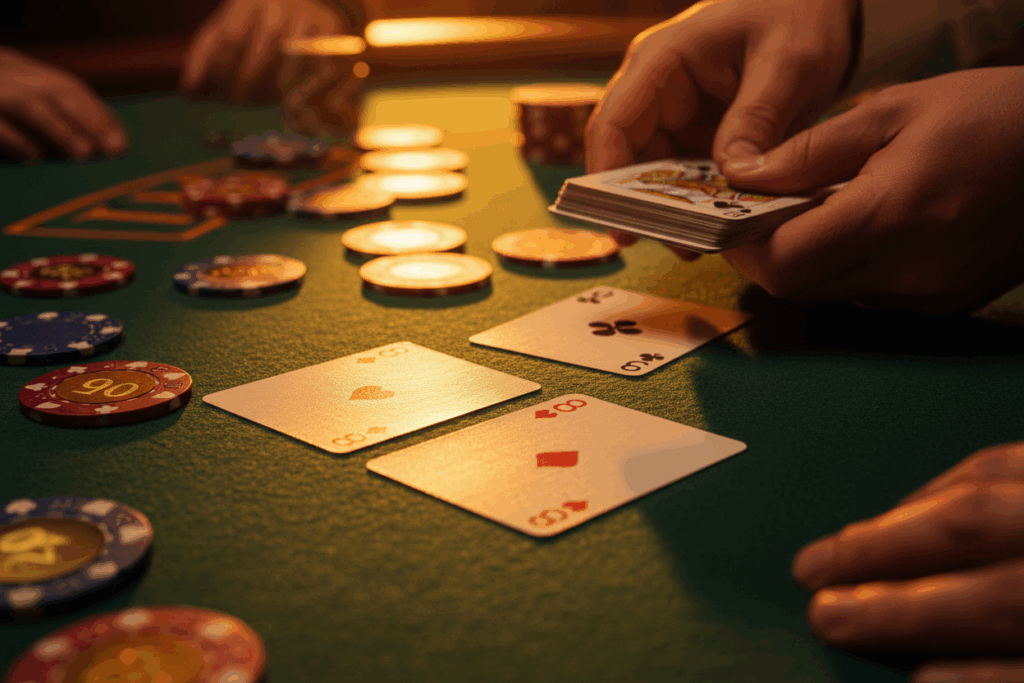
When you’re dealt a pair, you can split them into two hands. Each hand gets another card, and you place an equal bet on the new hand. It sounds like free money, but splitting can be both brilliant and disastrous depending on what pair you’ve got.
Here’s the simple breakdown:
✅ Always split Aces and 8s.
- Aces give you two chances at a strong starting hand (each can become 11 plus a 10).
- Eights split because 16 is one of the worst totals in blackjack. Two 8s give you a fresh start.
❌ Never split 10s or 5s.
- Two 10s make 20, why ruin that?
- Two 5s add up to 10, which is perfect for doubling down instead.
🤔 Sometimes split 2s, 3s, 6s, 7s or 9s.
- Split these if the dealer’s showing a weak card (2–6).
- Keep them together if the dealer’s showing something stronger.
This part of blackjack is where confidence starts to grow. The first time you split a pair of 8s against a dealer’s 6 and win both hands, you’ll see why experienced players love this move.
Soft vs Hard Hands: What That Actually Means
A “soft” hand includes an ace that can count as either 1 or 11. A “hard” hand doesn’t.
For example:
- Ace + 6 = Soft 17
- 10 + 7 = Hard 17
Soft hands give you more flexibility because you can take another card without risking an immediate bust. If you’ve got a soft 17 (A+6), hitting again is usually smart, because the worst you can end up with after one card is 17 (if you draw a 10).
Hard hands, by contrast, are less forgiving. If you’ve got 16 and you draw a 10, you’re done. So you play more cautiously.
Dealer Rules and Why They Matter
Most UK blackjack tables follow a standard rule: the dealer must hit until reaching 17. Some specify that they hit on “soft 17,” which slightly changes your odds.
If the dealer stands on all 17s, that’s slightly better for you, fewer chances of them hitting a winning number after you’ve stood.
Always check this before you start playing. Online games show this info clearly, usually above the table or on the info screen. It might not seem important, but a small detail like that can change your decision-making when the dealer shows an ace.
A Word on Strategy Charts
If you’ve ever seen those colourful blackjack charts online, they’re not cheating, they’re tools. They map out the mathematically best move for every hand combination. You don’t need to memorise the whole thing overnight, but they’re worth glancing at before you play for real money.
Most casinos won’t mind if you have one nearby during online play, and using them in free demo games can help you get a feel for which plays are considered “correct.” Eventually, you’ll find yourself making those calls naturally.
Avoiding Common Strategy Traps
Even with good intentions, players often fall into a few predictable mistakes:
- Standing on 12 against a dealer’s 2 or 3, statistically, you should hit.
- Doubling down too late, remember, you only get one extra card.
- Splitting tens, never a good idea.
- Ignoring soft hands, they’re more flexible than most people realise.
If you can avoid those, you’re already ahead of most casual players.
Good blackjack strategy isn’t about memorising hundreds of plays; it’s about building habits that make sense. You’ll still lose hands, everyone does, but you’ll lose fewer of the ones you should win.
Start by practising in low-stakes or free online blackjack rooms. Watch how often those “textbook” decisions play out well over time. Once you’re comfortable, move up to live dealer tables for that authentic experience; the thrill of turning over an ace when you’ve doubled down never gets old.