
Blackjack might look like a game of luck, but the truth is that most outcomes come down to maths. Don’t worry, we’re not diving into complex formulas or probability charts.
This guide is about making sense of the odds, so you know when the game’s on your side and when it isn’t. Once you understand how blackjack odds work, you’ll see why it’s one of the fairest games in any casino, online or in person.
The House Edge Explained Simply
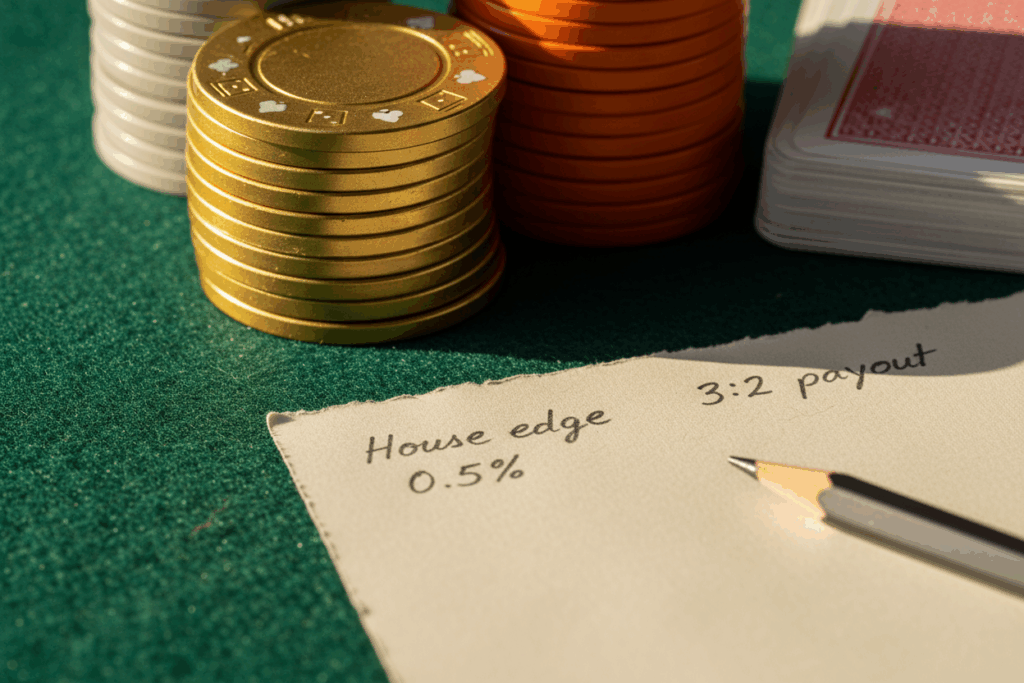
Every casino game gives the house a small advantage. That’s how they stay in business. In blackjack, that edge is surprisingly low, often between 0.5% and 2%, depending on the rules. That means that, on average, for every £100 wagered, the house expects to keep 50p to £2 in the long run.
The lower the house edge, the better your chances. Blackjack has one of the smallest edges around, especially compared to games like roulette or slots. That’s why so many serious players love it; it rewards smart decisions.
If you’re using basic strategy, you can reduce the house edge to around 0.5%. Skip the strategy and make random moves, and it can jump to 5% or more. That’s a big difference over time.
How the Deck Count Affects the Odds
Blackjack can be played with one deck or several. Single-deck games give you slightly better odds because it’s easier to predict what’s left in the shoe.
However, casinos prefer using multiple decks to protect themselves from advantage players and to make things less predictable. Most online blackjack tables use between six and eight decks.
The house edge changes a little depending on the number of decks:
- Single-deck: Around 0.15% edge (best for players)
- Double-deck: Around 0.35%
- Four to eight decks: Around 0.5%
If you ever spot a single-deck table online or in a UK casino, it’s worth trying. Just check the payout rules; some offset the advantage by paying 6:5 instead of 3:2 on blackjack, which flips the odds back towards the house.
Blackjack Payouts and How They Impact You
This part’s simple but critical. A traditional blackjack payout is 3:2. So if you bet £10 and hit blackjack, you win £15 profit. Some tables now offer 6:5, which means a £10 bet wins only £12. That smaller difference cuts your long-term return by about 1.4%. Always go for 3:2 tables when you can.
You’ll usually see this displayed on the felt or screen:
“Blackjack Pays 3 to 2”
If you don’t see it, check the game info tab before you play. Online casinos often mix rule sets, so a little reading goes a long way.
What the Dealer’s Rules Mean for You
In most UK blackjack games, the dealer has to draw cards until reaching 17. Some tables specify that the dealer hits on “soft 17” (that’s an ace and a 6). When that happens, it gives the house a slightly stronger position, about 0.2% better odds for them.
Tables where the dealer stands on all 17s are better for players. It’s a small margin, but it adds up. If you see “Dealer stands on all 17s,” that’s good news.
Why Basic Strategy Matters So Much
Blackjack isn’t about guessing; it’s about making the right decision based on the hand you’ve got and what the dealer’s showing. Basic strategy takes the maths behind every possible outcome and turns it into a simple guide. Following that strategy reduces the house edge to its lowest possible level.
Think of it like a sat nav for blackjack. You might not win every hand, but you’ll avoid wrong turns that cost you money.
Here’s a quick example of how the maths supports basic strategy:
- You’ve got 16, dealer shows a 10. The odds of busting if you hit are high, but the odds of losing if you stand are even higher. So you hit, because statistically, it’s the least bad option.
- You’ve got 12, dealer shows a 5. Now the dealer’s more likely to bust, so you stand. Over thousands of hands, that approach makes you lose less and win more.
Side Bets, Fun but Dangerous to Your Odds
Side bets can be tempting. You’ll see things like Perfect Pairs or 21+3, offering payouts of 10:1 or higher. They’re exciting, but they increase the house edge dramatically, often up to 6% or more.
They’re fine for entertainment, but if you’re serious about keeping your bankroll alive, treat them as extras rather than strategy. Think of them like ordering dessert at a restaurant, nice once in a while, but not the main course.
Why Card Counting Changes the Game
Let’s be honest, every blackjack player has heard of card counting. It’s been made famous by movies like 21 and Rain Man, but it’s not as glamorous as Hollywood makes it look. It doesn’t mean memorising every card, just keeping track of whether more high cards or low cards are left in the shoe.
In theory, if more high cards remain, the player has an advantage. That’s because blackjacks and strong totals (like 20) become more likely.
Casinos counter this by using multiple decks and frequent reshuffling. In the UK, online blackjack with random number generators (RNG) can’t be counted at all. Live dealer versions might give a small window of opportunity, but it’s not a reliable or practical way to win long-term.
Card counting isn’t illegal, but most casinos will ask you to stop if they spot you doing it. In short, learn it for fun if you’re curious, but don’t rely on it.
Understanding Variance and Why Short-Term Results Lie
You can play perfect strategy and still lose ten hands in a row. That’s variance, the natural swings of luck in the short term. The maths only evens out over hundreds or thousands of hands.
It’s why bankroll management matters so much. If you play within your limits and accept that bad runs happen, you’ll last long enough to see the odds balance out. Blackjack rewards patience more than any other casino game.
How Online Blackjack Keeps It Fair
Independent regulators like eCOGRA or iTech Labs test all UK-licensed online blackjack games. The random number generators are checked to make sure every deal is unpredictable and fair.
Live dealer games use physical cards and are streamed from real studios. The dealers shuffle regularly and follow the same rules you’d find in a land-based casino.
If you’re ever unsure, scroll to the bottom of the casino’s website and look for the UK Gambling Commission licence number. It’s the easiest way to confirm you’re playing somewhere legitimate.
Understanding blackjack odds doesn’t mean you’ll win every hand; no one does. What it gives you is control. You’ll make smarter choices, avoid bad tables, and manage your money with confidence.
Once you start spotting how small rule changes affect your odds, you’ll never look at a blackjack table the same way again. Next time you sit down, check the payout ratio, dealer rule, and number of decks before you even place your first chip. Those few seconds could be worth a lot over time.